
Comparing Varicose Vein Treatments: Which Is Right for You?
One of the most common questions patients ask is: 'Which treatment is the best?' The answer is simple: there is no single treatment that is best for everyone. Modern varicose vein treatment is highly individualised.
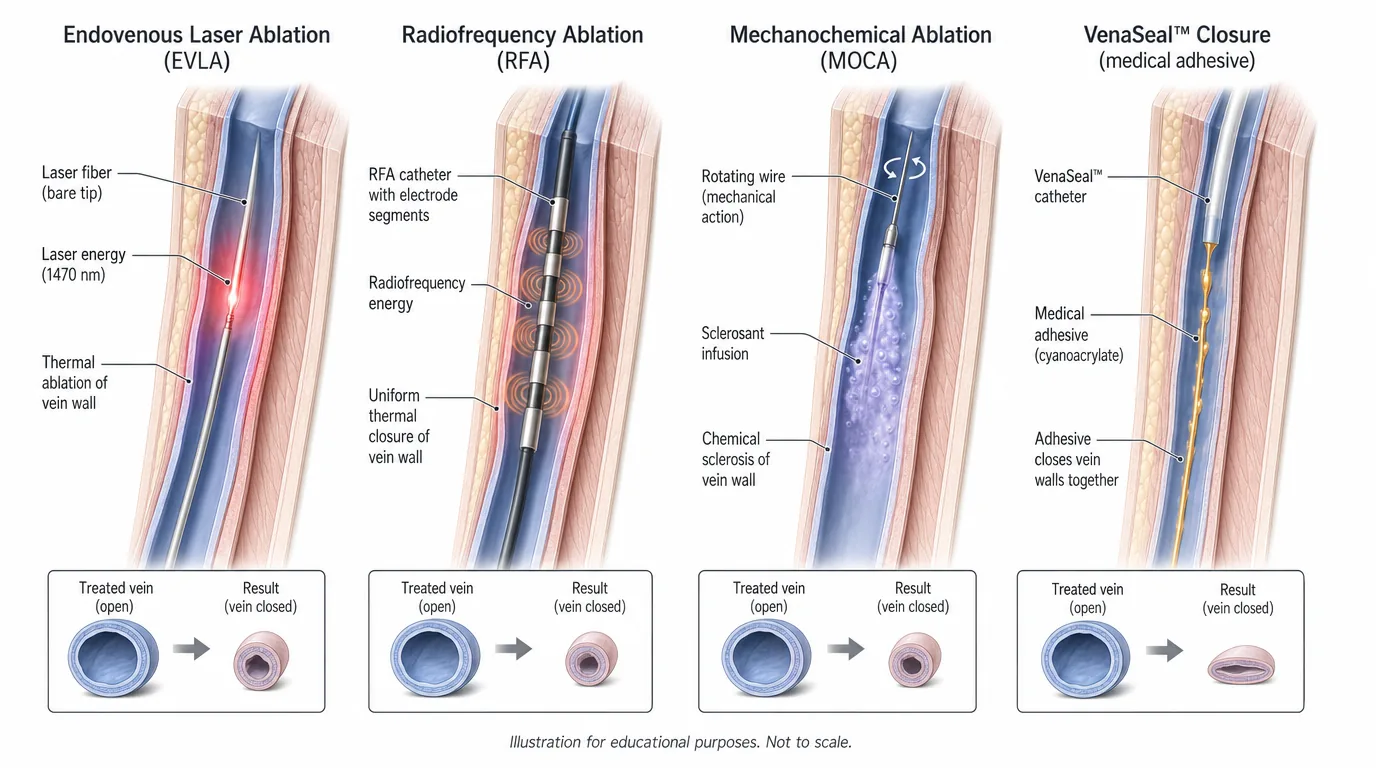
Illustration for educational purposes. Not to scale.
The most appropriate treatment depends on your duplex ultrasound findings, the anatomy of your veins, your symptoms, your general health and your personal preferences.
Before recommending any treatment, your vascular specialist will perform a duplex ultrasound scan to identify which vein is causing the reflux, the diameter and course of the vein, whether the vein is straight or tortuous, whether the deep veins are healthy, the presence of any previous vein thrombosis, and the severity of chronic venous disease. These findings are far more important than the appearance of the veins alone.
All four modern treatments — EVLA, RFA, MOCA and VenaSeal — aim to achieve the same goal: eliminating venous reflux by closing the diseased vein so that blood is redirected into healthy veins. The differences lie in how the vein is closed, what anaesthesia is required, the recovery profile, and the strength of long-term evidence.
For patients with suitable vein anatomy, Endovenous Laser Ablation (EVLA) and Radiofrequency Ablation (RFA) remain the most established treatments. They have been used for more than two decades and are supported by extensive clinical evidence demonstrating high long-term vein closure rates, durable symptom relief, significant improvements in quality of life, and low recurrence rates. Current NICE and ESVS guidelines recommend endothermal ablation as first-line treatment for most patients.
MOCA and VenaSeal are valuable alternatives for carefully selected patients. They may be considered when avoiding multiple tumescent anaesthetic injections is desirable, when a non-thermal technique is preferred, when the vein anatomy is suitable, or when individual patient circumstances favour these approaches. Although these techniques offer several practical advantages, they currently have less long-term outcome data than EVLA and RFA.
Open surgery is reserved for selected cases where vein anatomy makes minimally invasive approaches less suitable, or for recurrent varicose veins after previous treatment.
Your vascular specialist will recommend the most appropriate treatment after considering your ultrasound findings, the size and location of the affected veins, the pattern of venous reflux, previous vein treatments, your medical history, your occupation and lifestyle, recovery expectations, and your personal preferences.
Two people with similar-looking varicose veins may have completely different patterns of venous reflux and therefore require different treatments. This is why a duplex ultrasound scan is essential before any treatment is recommended. An experienced vascular specialist will explain the advantages and limitations of each option and help you choose the treatment that best suits your anatomy, symptoms and long-term goals.
Open Surgery or Endovenous Treatment — How Do They Compare?
Over the past two decades, the treatment of varicose veins has changed dramatically. While open surgery (high tie, ligation and stripping) was once the standard treatment, advances in technology have led to the widespread adoption of minimally invasive endovenous procedures, including EVLA, RFA, MOCA and VenaSeal.
Both approaches are effective in treating varicose veins by eliminating the underlying venous reflux. The main differences lie in how the treatment is performed, the recovery period and the patient experience.
Large clinical studies have shown that EVLA and RFA provide long-term success rates comparable to surgery, while offering important advantages such as less postoperative pain, less bruising, faster recovery, earlier return to work and normal activities, and lower risk of wound-related complications. For these reasons, current NICE and ESVS guidelines recommend endothermal ablation as the preferred first-line treatment for suitable patients.
Open surgery remains an important and effective treatment for selected patients. Your vascular specialist may recommend surgery if your vein anatomy is unsuitable for catheter-based treatment, the vein is excessively tortuous preventing safe passage of a catheter, you have recurrent varicose veins after previous treatment, or other anatomical or clinical factors make surgery the better option.
The choice between surgery and an endovenous procedure depends on your duplex ultrasound findings, the pattern and severity of venous reflux, the anatomy of the affected veins, your general health, previous vein treatments, and your personal preferences.
Today, most patients with suitable anatomy can be treated using minimally invasive endovenous techniques, allowing rapid recovery with excellent long-term results. However, the goal is not to avoid surgery at all costs — it is to select the treatment that offers the safest procedure, the most durable result and the best outcome for each individual patient.