
Radiofrequency Ablation (RFA): How It Works
Radiofrequency Ablation (RFA) is a minimally invasive treatment for varicose veins that closes the diseased vein from the inside using controlled radiofrequency (thermal) energy. Like EVLA, RFA treats the underlying cause of varicose veins by eliminating venous reflux and redirecting blood into healthy veins.
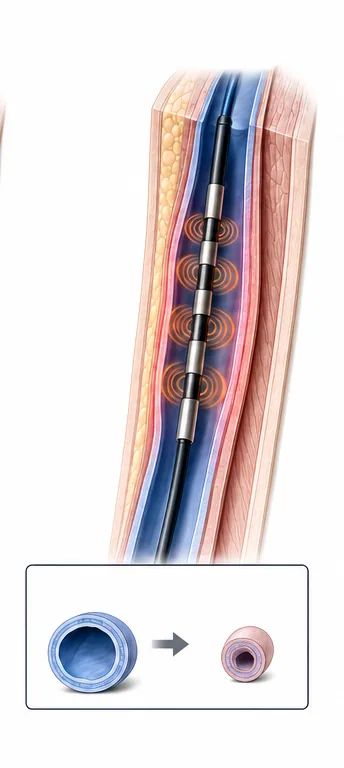
Illustration for educational purposes. Not to scale.
RFA is performed as a day procedure under local anaesthesia and allows most patients to return to normal activities within a few days.
During RFA, a thin catheter is inserted into the affected vein under ultrasound guidance through a small needle puncture. A dilute local anaesthetic solution, known as tumescent anaesthesia, is then injected around the vein to numb the treatment area, protect the surrounding tissues from heat, and compress the vein around the catheter to improve treatment effectiveness.
The radiofrequency catheter then delivers carefully controlled heat to the vein wall in short treatment cycles. This causes the vein to collapse and seal permanently. Over the following months, the treated vein is gradually broken down and naturally absorbed by the body. Once the diseased vein has been closed, blood is automatically redirected into healthy veins.
RFA is usually performed in an outpatient procedure room or day surgery centre. Most procedures take 30 to 60 minutes, depending on the number and complexity of the veins being treated.
Most patients experience very little discomfort during RFA. The local anaesthetic injections may cause a brief stinging sensation, while the treatment itself is generally well tolerated. Afterwards, it is common to experience mild bruising, tenderness or a feeling of tightness along the treated vein. These symptoms usually settle over the following days to weeks. Some studies suggest that RFA may result in slightly less bruising and post-procedural discomfort than EVLA, although both procedures are associated with rapid recovery and excellent patient satisfaction.
Clinical studies have demonstrated long-term vein closure rates exceeding 90–95%, excellent relief of symptoms, significant improvement in quality of life, and low recurrence rates when appropriately performed. Current NICE and European Society for Vascular Surgery (ESVS) guidelines recommend endothermal ablation — including both RFA and EVLA — as first-line treatment for suitable patients with symptomatic truncal venous reflux.
Serious complications following RFA are uncommon. Possible side effects include temporary bruising or tenderness, superficial vein inflammation (phlebitis), temporary numbness due to irritation of nearby skin nerves, skin pigmentation over the treated vein, incomplete vein closure or later recanalisation, deep vein thrombosis (rare), and skin burns or infection (very rare).
For most patients, both RFA and EVLA provide excellent long-term outcomes. Rather than asking which treatment is 'better,' the more important question is which treatment is most suitable for your particular vein anatomy and pattern of venous reflux. A duplex ultrasound scan provides the information needed to determine the most appropriate approach.