
VenaSeal™: Medical Adhesive Closure for Varicose Veins
VenaSeal™ is a minimally invasive treatment for varicose veins that closes the diseased vein using a specially formulated medical adhesive (cyanoacrylate). Unlike laser treatment (EVLA) or radiofrequency ablation (RFA), VenaSeal does not use heat, making it a non-thermal, non-tumescent (NTNT) treatment.
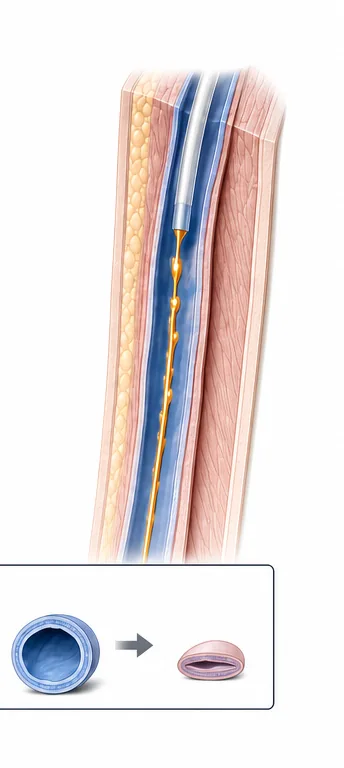
Illustration for educational purposes. Not to scale.
The procedure is performed as a day procedure under ultrasound guidance and requires only a small amount of local anaesthetic at the catheter insertion site. Because no heat is used, there is no need for the multiple tumescent anaesthetic injections required during EVLA or RFA.
During the procedure, a thin catheter is inserted into the diseased vein through a small needle puncture under ultrasound guidance. Small amounts of medical adhesive are delivered at carefully selected points along the vein while gentle pressure is applied externally. The adhesive seals the vein shut almost immediately, preventing blood from flowing backwards.
Over time, the treated vein becomes scar tissue and is gradually absorbed by the body. Blood is naturally redirected into healthy veins, improving venous circulation without affecting the overall blood supply from the leg.
The procedure generally takes 20 to 45 minutes, depending on the number and complexity of the veins being treated. Recovery after VenaSeal is usually very quick — most patients walk immediately, return home the same day, and resume normal daily activities within 24 hours.
Because the procedure does not involve thermal energy or tumescent anaesthesia, many patients experience minimal bruising or discomfort. Unlike thermal ablation procedures, compression stockings may not be required after VenaSeal, although practice varies between vascular specialists.
Large clinical studies have demonstrated that VenaSeal achieves high vein closure rates comparable to EVLA and RFA, with excellent symptom relief and significant improvements in quality of life. The main advantages include no thermal energy, no tumescent anaesthesia, rapid recovery, minimal post-procedural discomfort, and little or no need for compression stockings in many patients.
VenaSeal is generally very safe, but like all medical procedures, it carries some potential risks including mild bruising or tenderness, temporary inflammation along the treated vein, local skin pigmentation, incomplete vein closure or later recanalisation, allergic or inflammatory reactions to the adhesive (uncommon), and deep vein thrombosis (rare).
VenaSeal is an excellent treatment option for many patients, particularly those who wish to avoid thermal treatment or multiple tumescent anaesthetic injections. However, it is not necessarily the best treatment for everyone. A duplex ultrasound scan is essential before treatment because it accurately maps the pattern of venous reflux and helps determine the most appropriate approach.