
Understanding Varicose Veins: Causes, Symptoms and When to Seek Help
Varicose veins are enlarged, dilated and often twisted veins that develop most commonly in the legs. They occur when the one-way valves inside the superficial veins become weakened or fail to close properly, allowing blood to flow backwards instead of returning efficiently to the heart.
Although many people consider varicose veins to be a cosmetic problem, they are in fact a manifestation of chronic venous disease — a common medical condition affecting millions of people worldwide. The severity ranges from small visible veins causing minimal symptoms to advanced venous disease associated with skin damage and leg ulcers.
Today, effective minimally invasive treatments allow most patients to be treated as day procedures with rapid recovery, excellent long-term outcomes and significant improvement in quality of life. If your varicose veins are causing discomfort, swelling, skin changes, or are affecting your daily activities, an assessment by a vascular specialist can determine whether treatment is appropriate.
The veins in your legs have a challenging job. They must carry blood upwards against gravity, from your feet back to the heart. To prevent blood from flowing backwards, veins contain a series of one-way valves that open to allow blood through and then close to stop it falling back down.
When these valves become weakened or stop closing properly, blood leaks backwards — a condition known as venous reflux. The blood pools in the superficial veins, increasing pressure within the vein walls. Over time, this persistent pressure causes the veins to stretch, enlarge and become visible beneath the skin as varicose veins.
Varicose veins are extremely common. They affect an estimated 20–30% of the adult population, and the prevalence increases with age. They are more common in women than men, although men are also frequently affected.
Not everyone with varicose veins requires treatment. Many people have mild, asymptomatic veins that can be safely observed. However, for those with significant symptoms, progressive skin changes or complications, modern minimally invasive treatments — such as endovenous laser ablation (EVLA), radiofrequency ablation (RFA), mechanochemical ablation (MOCA) and cyanoacrylate closure (VenaSeal™) — offer excellent outcomes with rapid recovery and minimal disruption to daily life.
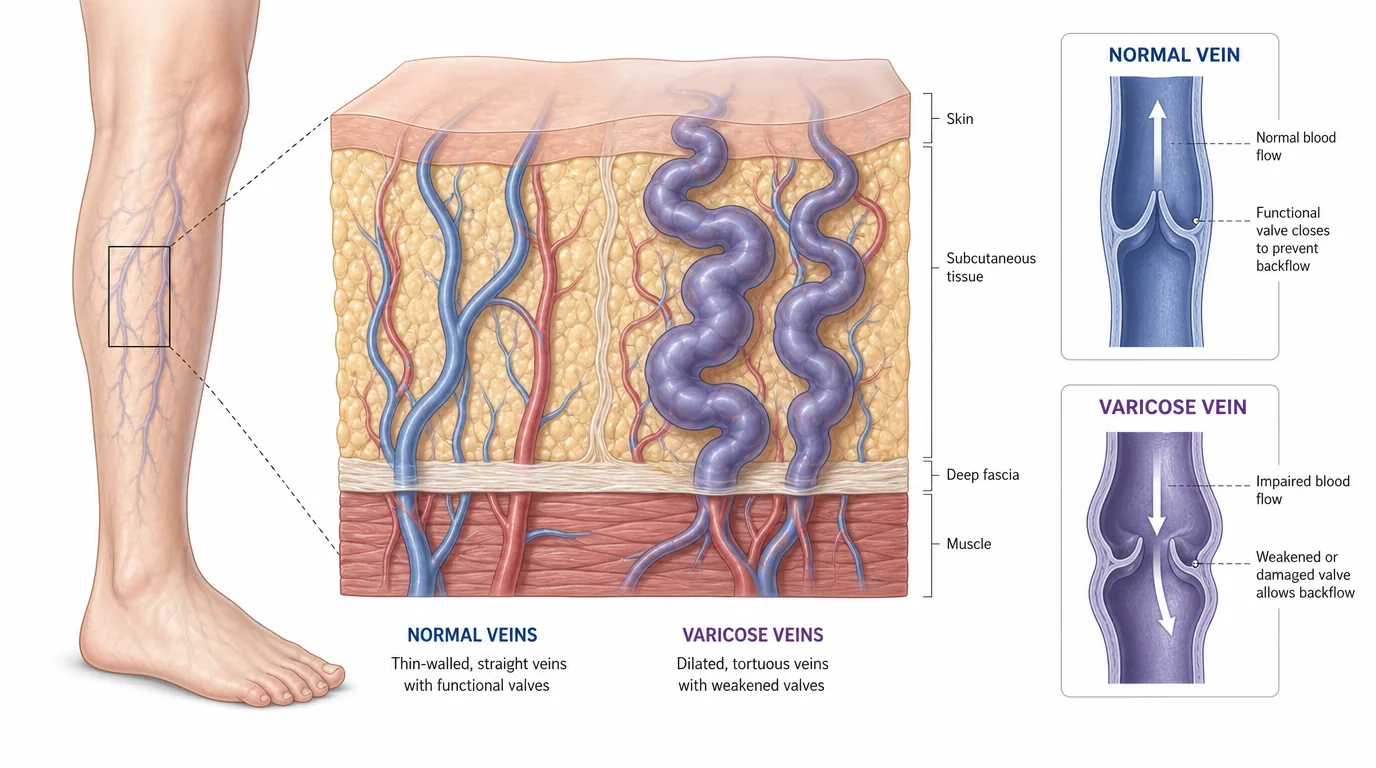
Figure 1. Normal veins have thin walls and functional one-way valves that prevent backflow. In varicose veins, weakened or damaged valves allow blood to pool, causing the vein to dilate and become tortuous. The cross-section shows how varicose veins develop within the subcutaneous tissue layer.
Explore This Topic
Symptoms & Warning Signs
Aching, heaviness, swelling — which symptoms matter.
Causes & Risk Factors
Genetics, pregnancy, standing — what drives venous disease.
How Veins Work
Understand the anatomy of leg veins and how valves prevent backflow.
Complications
Skin changes, bleeding, blood clots — what can happen if veins are left untreated.
Venous Leg Ulcers
How chronic venous disease can lead to leg wounds and how they are managed.
Blood Clots & DVT
Understanding the difference between varicose veins and deep vein thrombosis.
When to See a Specialist
Signs that it's time for a vascular assessment.