
Spider Veins and Varicose Veins — What's the Difference?
Spider veins and varicose veins are both forms of superficial venous disease, but they are not the same condition. Although they may occur together, they differ in size, appearance, symptoms and treatment. Understanding the difference helps determine whether treatment is needed and which option is most appropriate.
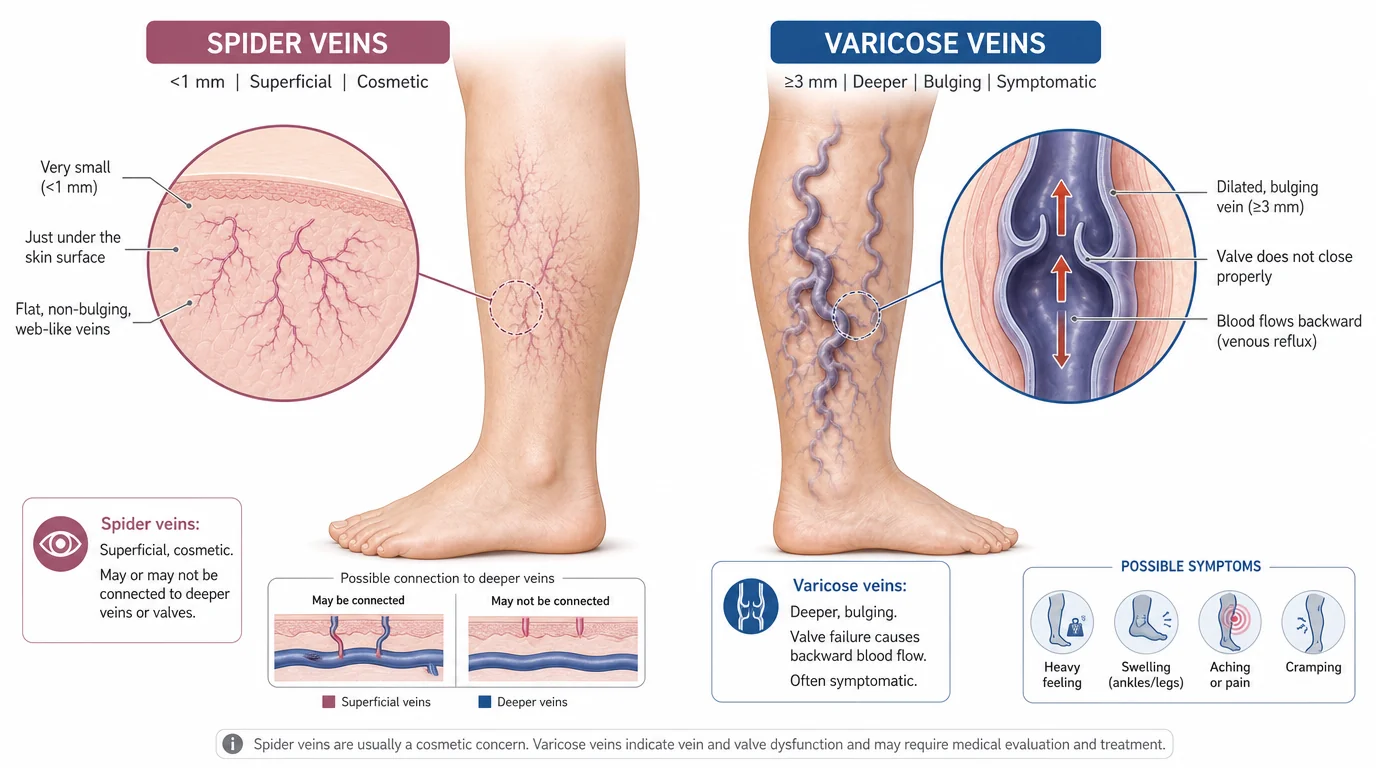
What Are Spider Veins?
Spider veins (also known as telangiectasia) are tiny dilated blood vessels located just beneath the surface of the skin. They usually appear as fine red, blue or purple lines, small web-like or branching patterns, and flat veins that do not bulge above the skin. Spider veins are most commonly found on the legs and face. They are usually a cosmetic concern, although some people experience mild burning, itching or aching.
What Are Varicose Veins?
Varicose veins are larger, swollen veins that develop when the one-way valves within the veins become incompetent, allowing blood to flow backwards (venous reflux). They typically appear as enlarged, bulging veins that are blue or purple and protrude above the skin in twisted or rope-like patterns. Unlike spider veins, varicose veins are more likely to cause symptoms such as aching or throbbing, leg heaviness, ankle swelling, night cramps, skin changes, and venous leg ulcers in advanced disease.
A Quick Comparison
| Feature | Spider Veins | Varicose Veins |
|---|---|---|
| Size | Very small (<1mm) | Larger (3mm or more) |
| Appearance | Flat, web-like patterns | Bulging, rope-like |
| Symptoms | Usually cosmetic only | Aching, heaviness, swelling |
| Underlying cause | May or may not have reflux | Venous reflux (valve failure) |
| Treatment | Sclerotherapy, surface laser | EVLA, RFA, MOCA, VenaSeal |
| Complications | Rare | Skin changes, ulcers, bleeding |
Can Spider Veins Become Varicose Veins?
Not directly. Spider veins do not usually "turn into" varicose veins. However, both conditions share similar risk factors, including genetics, ageing, pregnancy and hormonal influences. Some people develop both spider veins and varicose veins at the same time. Importantly, spider veins can sometimes be a visible sign of underlying venous reflux, particularly when they are associated with leg symptoms or occur around the ankle. Treating the spider veins alone without addressing the underlying reflux may lead to disappointing results or early recurrence.
Do Spider Veins Need an Ultrasound Scan?
Not always. If spider veins are purely cosmetic and there are no symptoms or visible varicose veins, a duplex ultrasound scan may not be necessary. However, a duplex ultrasound is recommended if you have aching or heaviness in the legs, ankle swelling, visible varicose veins, skin pigmentation or eczema, a history of venous thrombosis, or recurrent spider veins after previous treatment. The scan helps determine whether there is significant venous reflux that should be treated before addressing the spider veins themselves.
Which Treatment Is Right for Me?
The most appropriate treatment depends on the type of veins present. Spider veins are commonly treated with sclerotherapy or, in selected cases, surface laser therapy. Varicose veins are usually treated by correcting the underlying venous reflux using procedures such as Endovenous Laser Ablation (EVLA), Radiofrequency Ablation (RFA), Mechanochemical Ablation (MOCA) or VenaSeal™. Residual spider veins can then be treated later if required. Treating the underlying cause first often produces better cosmetic and long-term results.
The Bottom Line
Although spider veins and varicose veins may look similar, they are different conditions that require different treatment approaches. If your veins are associated with pain, heaviness, swelling, skin changes or other symptoms, a duplex ultrasound assessment is recommended to identify any underlying venous reflux. An accurate diagnosis ensures that treatment addresses the cause of the problem — not just its appearance.